Case study · Automotive field service
27 May 2026
An AI inbound agent, built into their WhatsApp
He was running every enquiry through his own WhatsApp by hand, qualifying and booking each one himself. Now an AI assistant handles the whole first conversation, and only the right leads ever land in his calendar.
His whole front desk ran out of one WhatsApp inbox. Every enquiry, every "is my car even suitable," every booking, and he answered every one himself.
It's a mobile engine-cleaning company, and the WhatsApp button on their website goes straight to the owner's phone. That's actually smart, because hardly anyone calls any more. WhatsApp is the UK's most-used messaging app, it's got over two billion users worldwide, and it gets read far more reliably than a text or an email ever will. The only problem was that he was the one reading and replying to all of it, qualifying tyre-kickers, explaining the same things ten times a day, and typing every booking in by hand.
What we built
An AI assistant plugged straight into his existing WhatsApp number. No new number, no app for the customer to download, nothing changes on their end. It just answers, and it runs the entire first conversation: it qualifies the lead, educates them on the work, quietly filters out the jobs he doesn't want, and books the right ones in.
Here's a real conversation it handled, start to finish:
It qualifies before it does anything else
Every conversation opens the same way. Before it talks price, process or anything else, it asks three things: the make, model and rough mileage, where they're based, and why they got in touch. It frames them as quick details so it can point them in the right direction, not an interrogation. The moment it has those answers, it already knows whether this is a job worth pursuing.
It actually knows the work
We didn't just give it a script. We loaded it with three knowledge bases — the company, the technical detail, and the services — so it can hold a real, honest conversation:
The company
Who they are, how they work, coverage areas, pricing ranges and the booking process.
The technical detail
What a carbon clean actually does, the four realistic outcomes, and what it can't touch — DPFs, EGR valves, inlet manifolds.
The services
Every service on offer, what suits which symptom, and why it always starts with a diagnostic before anything else.
So when someone describes a problem, it asks the right follow-ups, sets realistic expectations, and is upfront about when something needs a garage instead. It never overpromises, and it never sends a good lead away just because one part of the job isn't theirs.
Inside the conversation
Under the friendly chat, every message runs through the same logic — qualify, understand, filter, and only then hand over:
It filters out the jobs he doesn't want
This is the bit that quietly saves the most time. Before a single lead reaches him, the assistant silently runs it through a set of disqualification checks, and politely declines the ones that aren't a fit:
- Wrong vehicle — HGVs, lorries, buses, coaches, anything on a 24V system. The kit is built for cars and standard vans.
- Engines it can't service — rotary and Wankel engines, where the process simply isn't compatible.
- Out of area — anyone clearly outside the coverage region gets an honest heads-up rather than a wasted booking.
- Unrelated work — MOTs, remaps, tyres, general garage jobs get politely pointed to a local garage.
He never sees those conversations. He only ever picks up qualified, in-area, ready-to-book leads.
It knows when to get a human
Automation that bluffs is dangerous. So if the assistant hits a question it genuinely can't answer, a keyword that needs a person, or a real edge case, it stops and hands the conversation straight to the team rather than making something up. The customer never feels the seam.
It chases the quiet ones
Plenty of leads go cold mid-chat and never get followed up. This one doesn't let them. If a conversation goes dead, it automatically follows up after 24 hours to nudge the lead back to life — the kind of admin a busy owner never gets round to.
Then it books them
Only once a lead is qualified and they understand exactly what they're getting does it hand them to the self-serve booking page — the same system we built for the booking side of the business. They drop in a postcode, pick their services, and book the nearest technician. He doesn't touch it.
In full swing
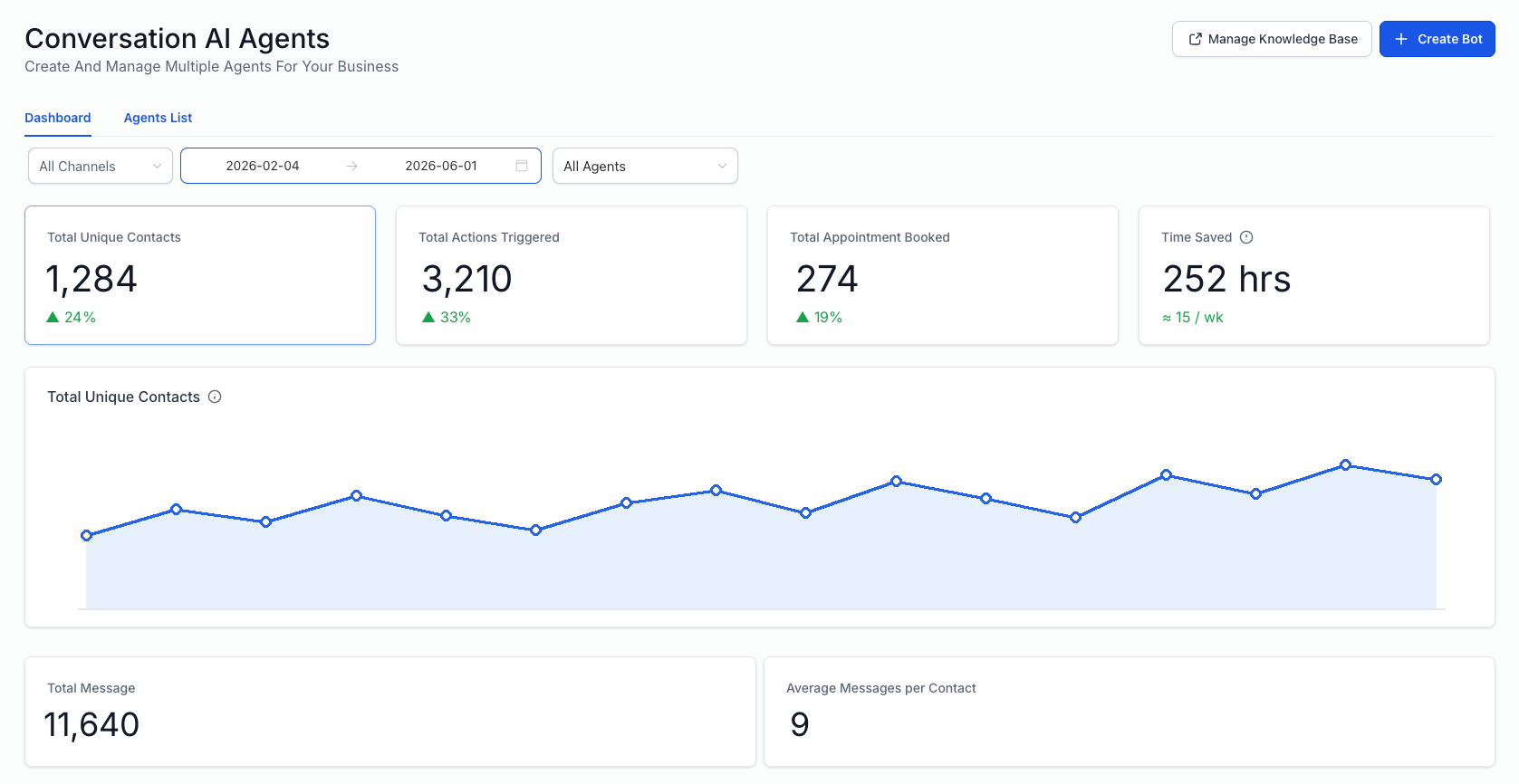
Wired into one WhatsApp number, this is what the owner now sees instead of a buzzing phone:
The result
He got about 15 hours a week back. He's out of the qualifying-and-explaining business entirely. The assistant deflects the wrong leads, educates the right ones, and books on-site consultations straight into his calendar, on the channel his customers already prefer.
Better still, every lead that reaches him is already a good one. No more answering the same questions at 9pm, no more politely turning away the jobs he was never going to take.
He used to live in his WhatsApp. Now it works for him, around the clock, and only the booked jobs land on his plate.
Drowning in messages from leads?
Book a free AI Blueprint call. We'll find what's eating your week and map out exactly what to automate first.
Get a free AI Blueprint